

Ad tech companies offer similar core components, and much of that infrastructure is table stakes, yet two engineering factors still explain why one technology performs better than another: an SDK that provides contextual and performance data, and ML models that use it to make bidding and ad-serving decisions.
Why SDK-first
A proprietary SDK puts a company closest to the publisher, and closest to the data source, which makes it one of the two main differentiators in ad tech.
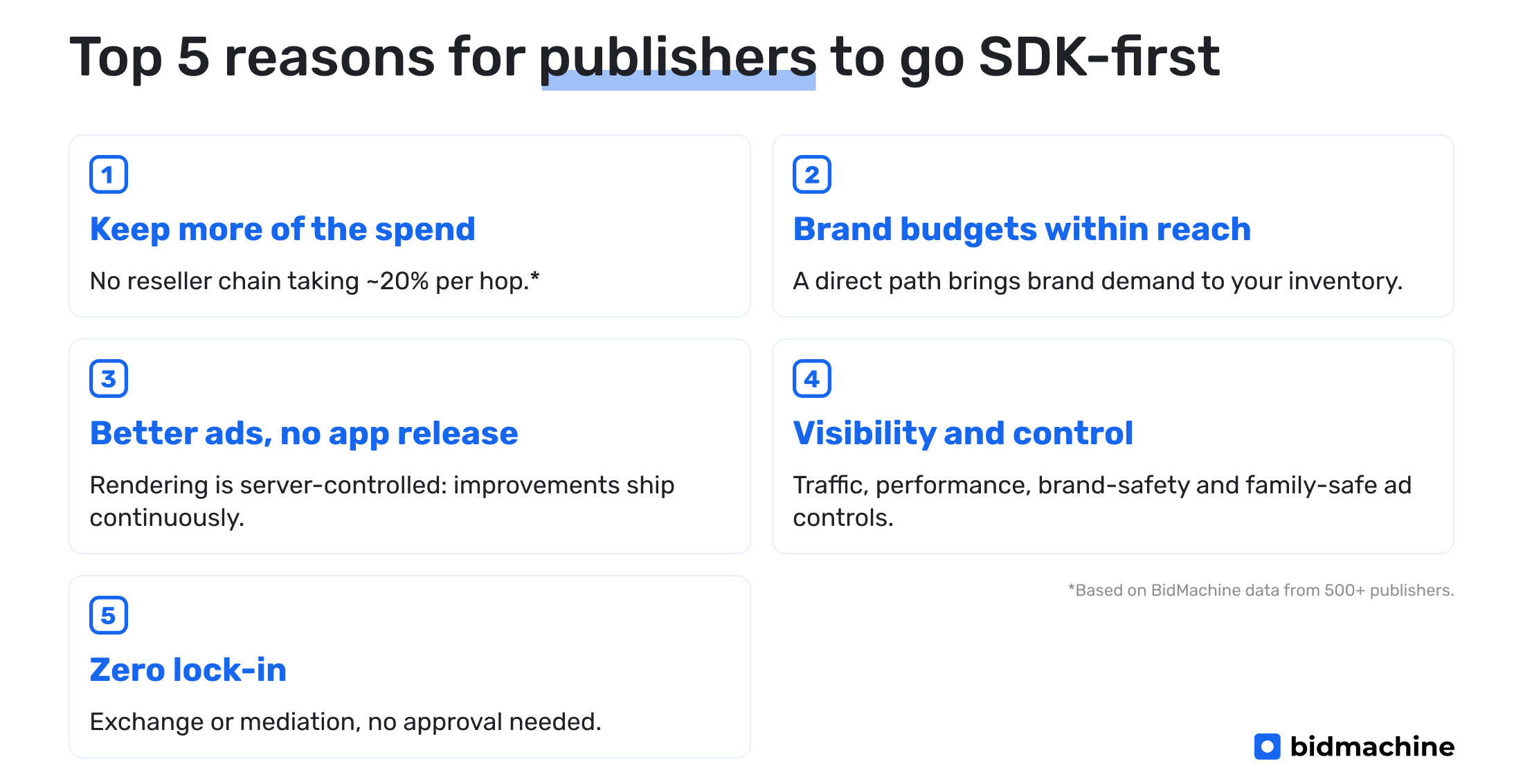
When ad inventory passes through third-party networks, every intermediary repackages the request and takes a fee. As a result, the context passed downstream becomes less granular, leaving the models with less information, and the publisher keeps a smaller share of the spend. Based on BidMachine data from more than 500 publishers, each additional reseller takes roughly 20% of the remaining spend, and the longest chains we see reach six hops. At that rate, a publisher would keep only about a quarter of the original amount.
Because BidMachine is SDK-first, you're buying and selling inventory one step from the source, not several hops down a reseller chain. Nearly all of our impressions come through direct SDK integrations with gaming and non-gaming publishers, which means the context that usually gets stripped away by intermediaries stays intact: the full ad-experience lifecycle, including video playback milestones, tracked clicks and engagement events. For buyers, that means sharper targeting and measurement, and for publishers, more of the spend stays with you instead of funding middlemen. This setup also brings scale: ad opportunities from more than 600 million daily active users, subject to platform permissions and users' privacy choices.
And because the rendering layer is server-controlled, improvements ship continuously without waiting on an app release. You get a better ad experience over time, with no update to push.
A shorter path to demand
OpenRTB gave programmatic advertising a common standard, and with it came scale and dynamic pricing, but it did not expand the pool of ad budgets. The result is renewed interest in direct relationships between buyers and publishers, with the data and measurability of programmatic. Supporting this model is another expectation the market now places on an SDK.
BidMachine Direct Placements gives demand partners that path: SPO buys with transparent media costs and a straight line to the publisher, so you see what you're paying for and who you're reaching. Mobile app inventory meets brand budgets without the markup and opacity of the reseller chain in between.
For publishers, this access doesn't mean lock-in. One SDK connects you directly to buyers through BidMachine or to other ad networks through mediation, and you move between them whenever you want. No approval, no penalty, no switching cost.
Choosing the right ad
Data informs ad selection within milliseconds, and millions of these decisions are made every second: which impression to bid on, at what price, at what moment and which placement is most likely to deliver the intended result. This is where machine learning becomes the second major source of technological differentiation in mobile advertising. Using the context provided by the SDK, ML models identify patterns in transactional data and estimate the likelihood of an outcome such as a view, click or install.
Machine learning has been used in ad tech since long before the AI boom. Today, much of it is described as AI, but that does not make it any less machine learning. Real-time decisioning continues to rely on specialized models because generative AI is still too slow and expensive for this kind of work.
However, AI plays a different role in the client-facing layer, acting as a new type of interface that makes the platform easier to interact with. It helps analyze reporting faster, build more precise audiences, adjust campaigns or create multiple variations from a single marketing brief. AI simplifies how people talk to the system, not how bids or impressions are evaluated in real time.
What transparency means now
For an ad tech platform to remain part of a publisher's stack, it needs to provide financial and operational transparency at the most basic level. This means the SDK runs reliably inside the app, and reporting shows how much has been earned and spent at any given moment.
As the business grows, this level alone is no longer enough. Teams want to understand where traffic comes from, where it goes, how performance changes and which actions could improve it. Publishers also need control over the quality of the environment, including brand safety, Open Measurement, child protection and the content users interact with. The same now applies to data: the operating system defines the permissions, the app obtains the user's consent and the SDK operates within what both have granted. That consent is meaningful only when each of the three does its part.
This is how expectations around SDK data are evolving, from basic reporting to a fuller view of how money, traffic, content and data move through the system.
Agentic access is the next commodity
Transparency will become even more critical as external autonomous AI begins operating within shared infrastructure. Its entry requires agent harnesses: controlled execution layers that define access, permitted actions and the points where human or system-level approval is needed. Without that structure, one actor can compromise the results of others.
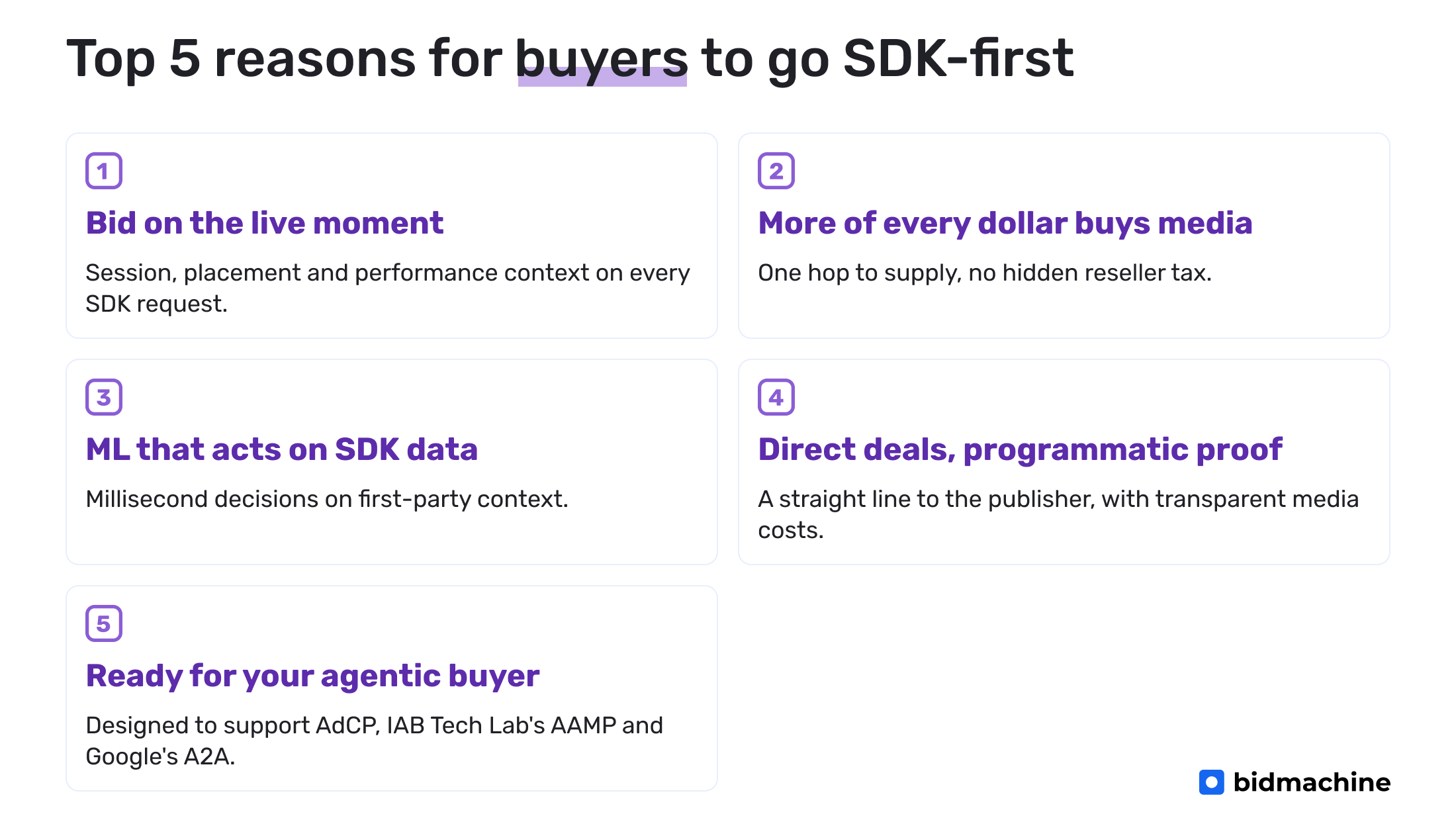
As automated buyers arrive, the question for both sides is whether your stack is ready for them. BidMachine's first step is a native seller agent, currently in pilot, that lets AI demand discover inventory, negotiate terms and create deals directly. For buyers, that means you can transact through whichever agent framework you've adopted: the platform is designed to support protocols such as AdCP, IAB Tech Lab's AAMP and Google's A2A through one backend, so you're not locked into a single protocol. A shared deal store, state machine and audit trail keep terms consistent across all three.
For publishers and the integrity of the marketplace, autonomy doesn't mean a free-for-all: every buyer is authenticated, with trust scoring in place as the pilot scales. Negotiations stay within set price boundaries and every action is logged for audit, so opening the exchange to agents doesn't mean losing control of who transacts or on what terms.
This new environment does not make reliable data less important, so the gap between good and poor inputs becomes only more consequential. If an agent guides growth strategy, degraded inputs can push it in the wrong direction, which is why an SDK-first setup remains the differentiator.
Want to see how our SDK could work for your business? Talk to the team.